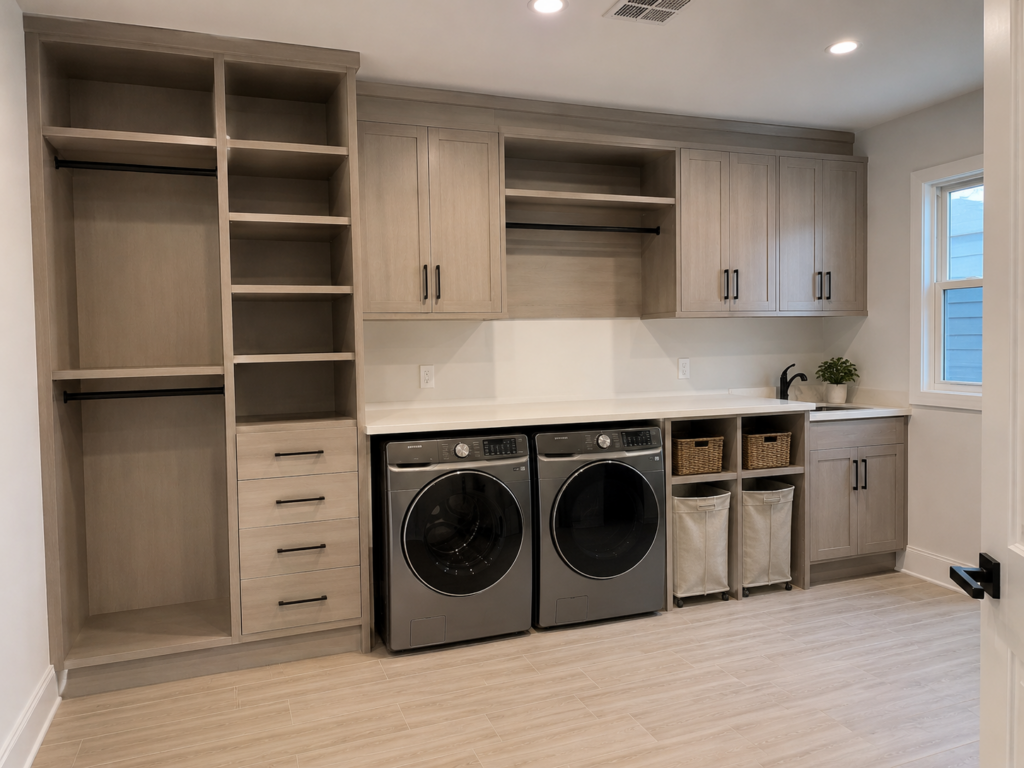
Short answer: for most South Florida homes, porcelain tile is the most durable and water-tolerant choice, rigid-core luxury vinyl plank (LVP) is the best fit when you want a wood look, a softer and quieter floor, or a faster install, and engineered wood works best in climate-controlled living areas where you’re committed to keeping indoor humidity steady. The right answer changes room by room, and HOA rules or flood risk can rule options out before style even comes into it.
Below is how the three compare on the things that matter most in Boca Raton, Delray Beach, Boynton Beach and the rest of Palm Beach County: humidity, water, sand, noise and long-term upkeep.
Quick comparison
| Porcelain tile | Rigid-core LVP (SPC/WPC) | Engineered wood | |
|---|---|---|---|
| Handles water and spills | Excellent — very low water absorption | Planks are waterproof; water sitting in seams is the weak point | Limited — wood is sensitive to moisture |
| Humidity sensitivity | Very low | Low | High — warranties usually require steady indoor humidity |
| Feel underfoot | Hard and cool | Softer and warmer, quieter | Warm, natural wood |
| Scratch / sand resistance | Very high | Good (depends on wear layer) | Moderate — real wood surface can scratch and dent |
| Flood-resistant by FEMA’s definition | Yes, when set in mortar | Not specifically rated — depends on product and adhesive | No |
| Best rooms | Whole home, kitchens, baths, laundry, entries | Bedrooms, living areas, rentals | Bedrooms, living and dining rooms |
Porcelain tile: the South Florida standard
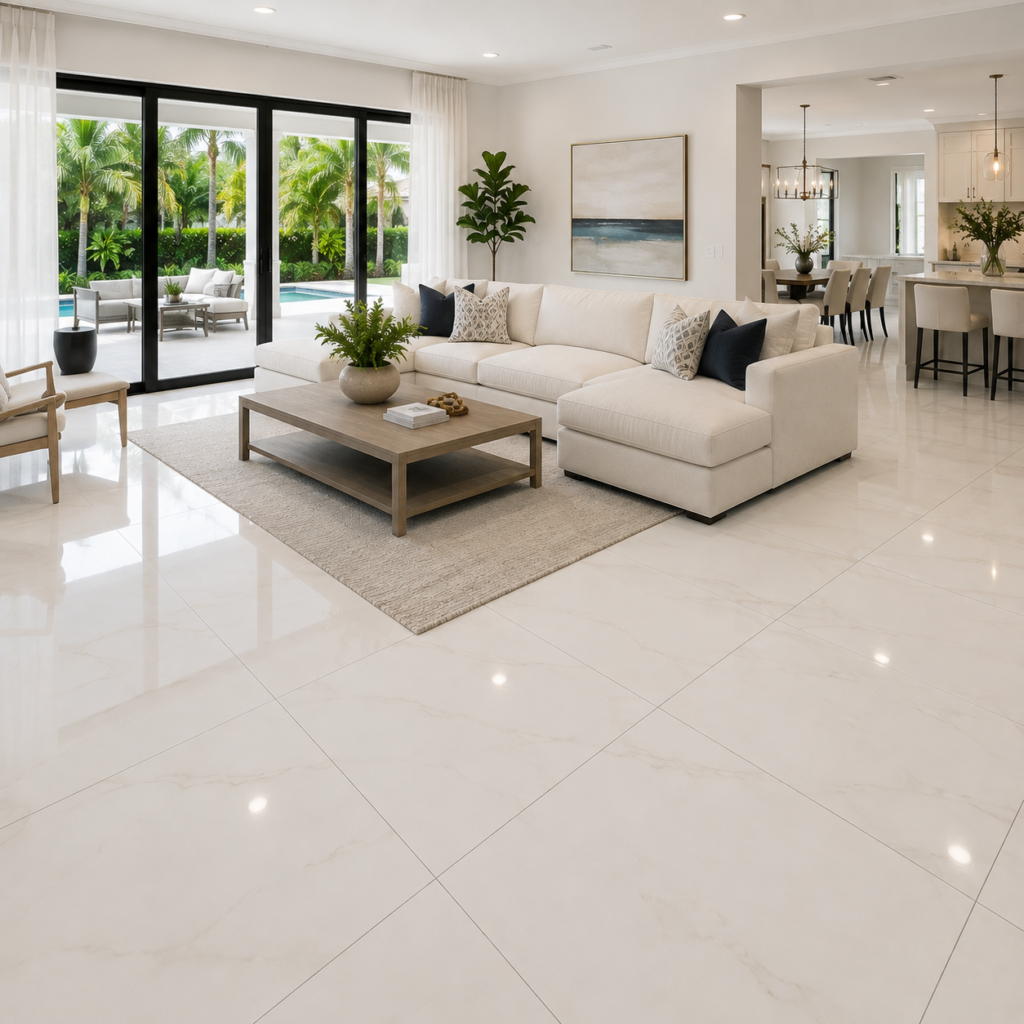
Porcelain is a type of ceramic tile, but it’s denser. Under the American National Standard for ceramic tile (ANSI A137.1), a tile only counts as porcelain if it absorbs 0.5% or less of its weight in water. That’s why it shrugs off spills, wet feet coming in from the pool and the general dampness of a coastal climate.
Why homeowners here choose it: it doesn’t care about humidity, sand won’t scratch a quality porcelain surface the way it scratches wood, and it can run continuously from the kitchen into living areas and out toward the patio for a clean, open look. Large-format tiles also mean fewer grout lines to clean.
Trade-offs: it’s hard and cool underfoot, it’s louder than vinyl, and installation takes longer because the floor must be flat and the tile is set in mortar. Dropped glassware breaks.
Luxury vinyl plank: the practical wood look
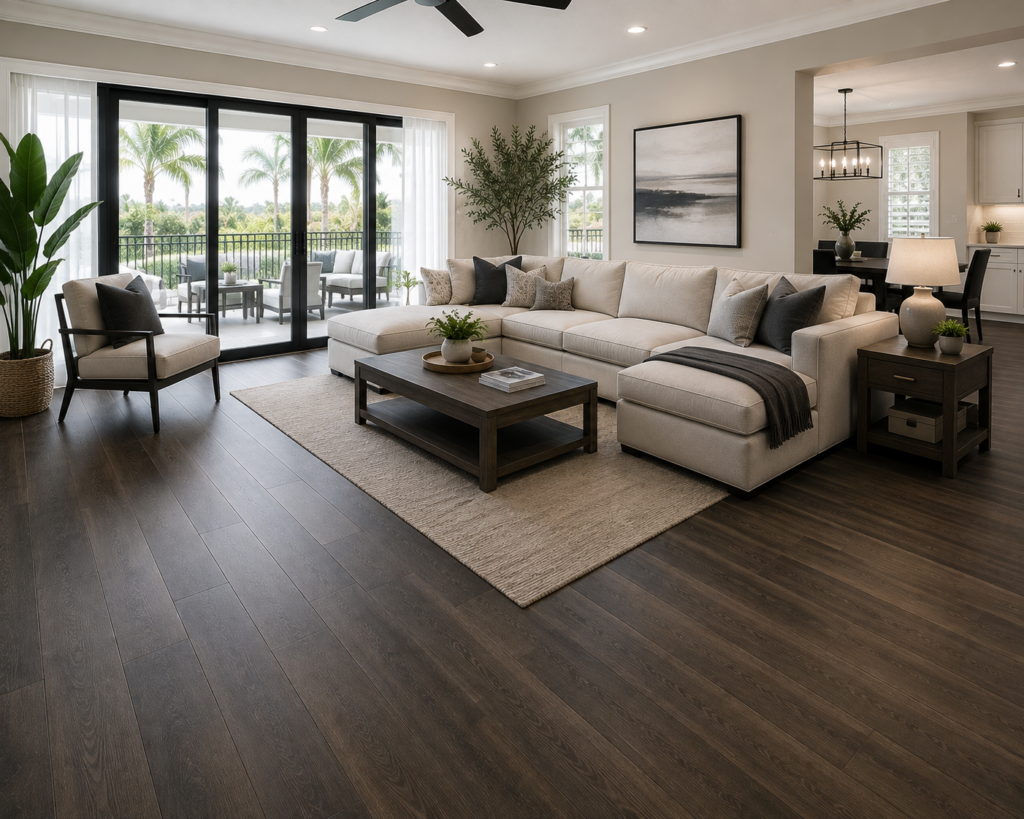
Most LVP sold today is rigid core, and there are two kinds:
- SPC (stone polymer composite): a dense limestone-and-polymer core. It’s more rigid, more dent-resistant and more stable when temperatures swing — a good match for sunny rooms with big windows.
- WPC (wood polymer composite): a lighter, foamed core that feels softer and a little quieter underfoot.
Why homeowners choose it: it looks like wood without wood’s moisture problems, it’s warmer and quieter than tile, it usually installs faster as a floating floor, and it’s forgiving for kids and pets.
Trade-offs: “waterproof” describes the plank, not the whole floor. On a floating floor, water that sits in the seams or runs to the edges can reach what’s underneath, so spills still need to be wiped up. Quality varies a lot by brand and wear-layer thickness, and heavy furniture can dent softer cores.
Engineered wood: real wood, with conditions
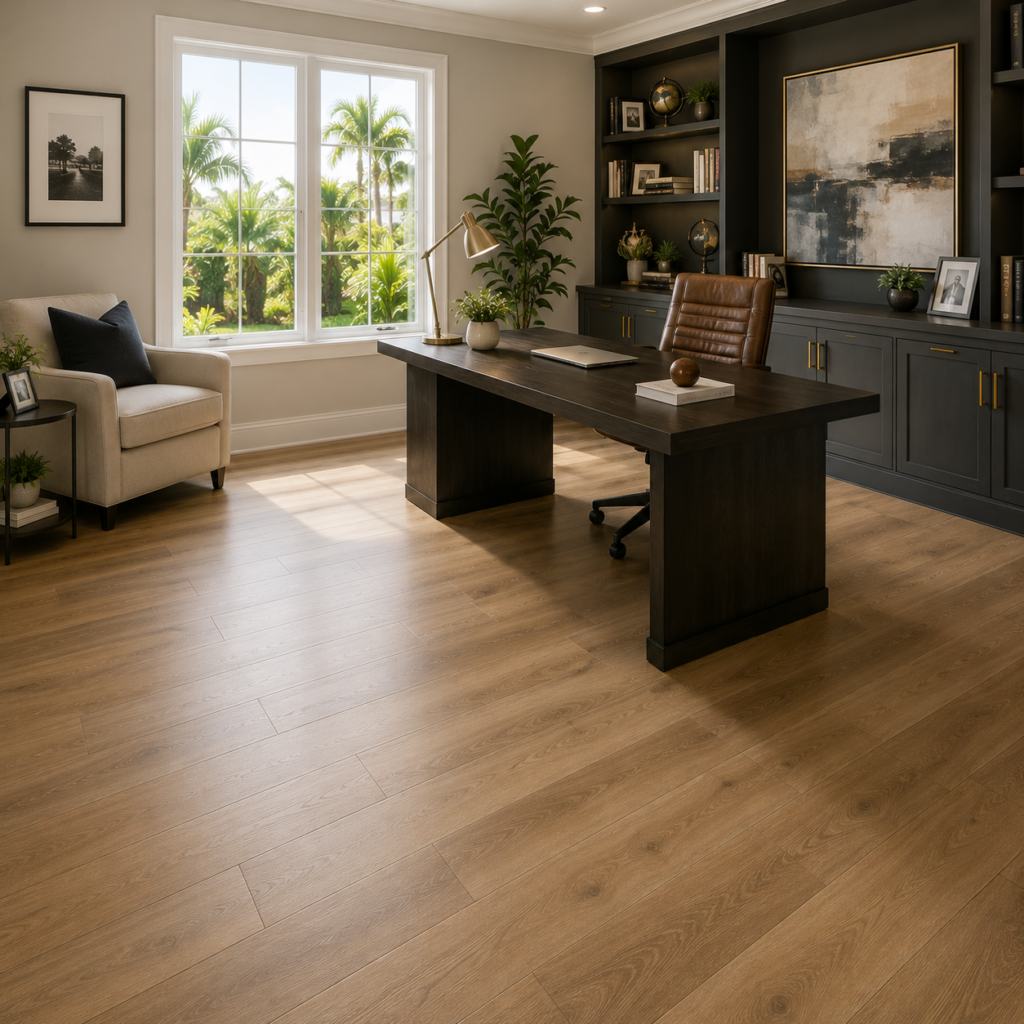
Engineered wood has a real hardwood top layer over a layered core, which makes it more stable than solid hardwood. It’s the choice when you want the warmth and character of actual wood.
The South Florida catch is humidity. Engineered-wood manufacturers commonly require indoor relative humidity to stay between about 35% and 55% year-round, and their warranties can exclude damage from moisture or humidity. In practice, that means the air conditioning has to run consistently — including while you’re away for the summer — and the floor doesn’t belong in bathrooms, laundry rooms or right inside a pool door.
Trade-offs: the surface scratches and dents more easily than tile or good LVP, and it’s the least forgiving of the three if water gets on it.
What’s different about choosing floors in South Florida
Flood risk
If your home is in or near a flood zone, material choice matters beyond looks. FEMA’s 2025 technical bulletin on flood damage-resistant materials lists ceramic and porcelain tile set in mortar as acceptable flooring. It lists wood floor coverings — including engineered wood, solid wood and plastic laminate — as unacceptable. Rigid-core vinyl isn’t named in FEMA’s tables, so whether it qualifies depends on the specific product and how it’s installed.
HOA rules
Many South Florida communities have HOA rules about flooring changes, such as approval before work starts, contractor insurance certificates and allowed work hours. Check your HOA’s written requirements before choosing a product.
Sand, pets and pool traffic
Beach sand works like sandpaper. Porcelain handles it best; good LVP with a thick wear layer is next; engineered wood will show it fastest. Mats at every exterior door help any floor.
Permits
Florida’s HB 803 created a $7,500 building-permit exemption in July 2026, but Palm Beach County’s building department says it doesn’t apply in the county, because the whole county is designated a flood hazard area. Plan on a permit for flooring work and check with your city’s building division. Here’s what the $7,500 permit exemption means in Palm Beach County.
Our room-by-room rule of thumb
- Kitchens, bathrooms, laundry rooms, entries, rooms off the pool: porcelain tile.
- Bedrooms and living areas in a single-family home: porcelain for a seamless look, or LVP or engineered wood for warmth.
- Homes left empty for the summer: avoid engineered wood unless humidity is controlled the whole time.
Frequently asked questions
Is porcelain better than ceramic tile for floors?
For most floors, yes. Porcelain is a denser type of ceramic tile that absorbs 0.5% of its weight in water or less, so it handles moisture and heavy traffic better. Standard ceramic can work well in lower-traffic indoor rooms.
Is luxury vinyl plank really waterproof?
The planks themselves are. The installed floor isn’t sealed, though — water left standing in seams or at the edges can get underneath. Wipe up spills and treat a leak or flood as a real water problem.
Can I put engineered wood in a Florida home?
Yes, in climate-controlled living areas, as long as indoor humidity stays within the manufacturer’s required range — commonly about 35% to 55% — all year. Keep it out of bathrooms, laundry rooms and areas that get wet.
Can flooring go over my existing tile?
Sometimes. It depends on whether the old tile is flat and well bonded, how much floor height you can add at doors and cabinets, and the new product’s installation instructions. We check this during the estimate.
Get a flooring recommendation for your home
United Eagle Construction installs porcelain and ceramic tile, luxury vinyl plank and engineered wood throughout Boca Raton, Delray Beach, Boynton Beach and Palm Beach County. We’ll look at your rooms, your subfloor, any HOA rules and how you live, then recommend the floor that fits. See our flooring installation services, or if new floors are part of a bigger project, our kitchen remodeling and bathroom remodeling pages.
Prefer to talk? Call 561-708-5540. Licensed & insured · FL License #CRC1336356.